Even Realities · Heads Up · Exchanges & Stocks

Your stop-loss finally waits for the candle to close.

Even G2 · 576 × 288simulator frame, recoloured
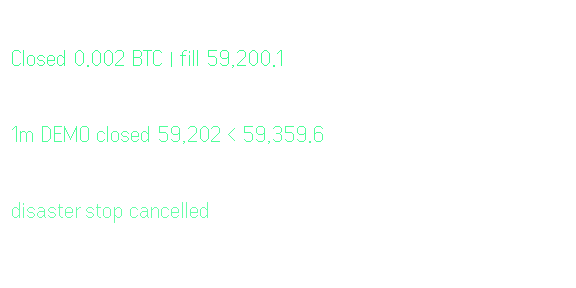
Closed 0.002 BTC | fill 59,200.1 / 1m DEMO closed 59,202 < 59,359.6 / disaster stop cancelled
01:51:01.767Z Closed 0.002 BTC | fill 59,200.1

On a 1H chart, price wicks through your line and snaps back; a plain stop has already sold. Close Call waits for the candle to close and counts the last seconds down on Even G2 (so far in the simulator). One tap skips this close; no tap, and a close past your line sends a reduce-only order on Binance testnet. In 500 testnet hours, 107 of 259 plain-stop hits were only wicks.

testnet only · reduce-only · not financial advice
disaster stop: a wide stop held by Binance itself, there if our server, phone or glasses die
your API key stays on the machine that runs the server

bar 2 of one Binance testnet run, 2026-11-29 01:50 UTC · 1m DEMO · staged line 59,359.6loop from T−8 s · frames swap in at their screenshot times (the display can trail by up to 1 s) · the Closed card’s copy has changed since; see the wall

41.3%

of plain-stop hits were only wicks

107 of 259 · descriptive replay, not P&L · wedge-replay.json
408ms

p50 from the bar boundary until Binance’s close event arrived

n = 13, max 2,051 ms · BENCH.md
689ms

p50 for the reduce-only close, send to response

7 real testnet fires, max 750 ms · BENCH.md
194

Vitest tests on the money path and the lens

149 server + 45 lens · README

Read it. Hold to arm. Tap to skip.

That is the core loop on the glasses: one gesture each, no dictation, nothing to type. Three real frames from the same testnet run.

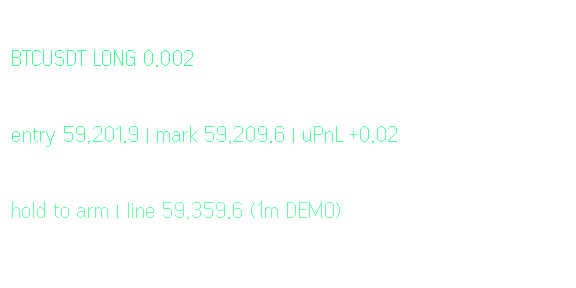
  1. BTCUSDT LONG 0.002 / entry 59,201.9 | mark 59,209.6 | uPnL +0.02 / hold to arm | line 59,359.6 (1m DEMO)
    Readposition at a glance

    Size, entry, mark and uPnL from Binance, and the line you set on the phone.

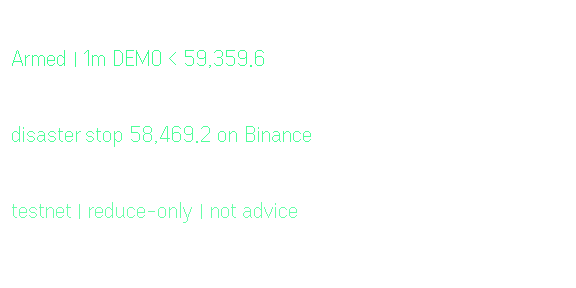
  2. Armed | 1m DEMO < 59,359.6 / disaster stop 58,469.2 on Binance / testnet | reduce-only | not advice
    Holdlong press

    A long press arms the rule. Binance must accept the disaster stop first, or nothing is armed.

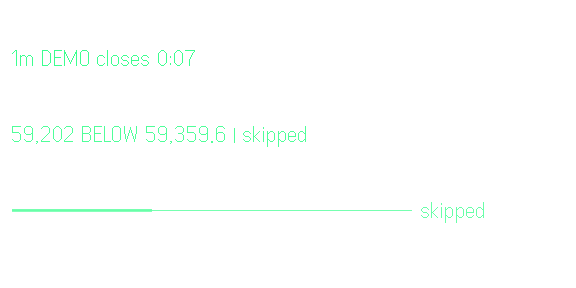
  3. 1m DEMO closes 0:07 / 59,202 BELOW 59,359.6 | skipped / bar frozen, skipped
    Taptouchpad click

    In the last seconds, one tap skips this bar’s close. The next bar decides again.

T−20 s · one testnet run, two bars

Tap, or let the close decide.

Both bars come from one run on Binance Futures testnet, driven through the Even Hub simulator’s touchpad. On bar 1 a tap 6.8 s before the close skips it. On bar 2 nobody taps: the candle closes under the line and a reduce-only order fills.

bar 2 · 01:50 UTC · 1m DEMOrecorded frame, recoloured
Closed 0.002 BTC | fill 59,200.1 / 1m DEMO closed 59,202 < 59,359.6 / disaster stop cancelled
T+06.00s
  • menu opened mid-countdown: clock and WebSocket kept
  • frames from the 01:49 UTC run; later copy edits changed some lens lines (today’s Closed card is on the wall below)
  • fill stamped 1,283 ms after the close: the 1,000 ms grace ran out, the close event arrived at 1,016 ms, the order 283 ms after the grace
  • FILLED 0.002 @ 59,200.1 · testnet order 28699824914 · the disaster stop was already gone once flat
closecall server + simulator driver · testnet.binancefuture.com2026-11-29 UTC
  1. 01:50:45.999ZT−14.00smenumenu opened (simulator driver input); clock and WebSocket kept
  2. 01:51:01.017ZT+01.02sclosingClosing | 1m DEMO closed 59,202
  3. 01:51:01.218ZT+01.22sorder-sendPOST /fapi/v1/order SELL 0.0020 MARKET reduceOnly
  4. 01:51:01.283ZT+01.28sbinanceorderId 28699824914 status FILLED executedQty 0.0020
  5. 01:51:01.766ZT+01.77sstop-cancelleddisaster stop already gone: Binance removed it once flat (cancel answered -2011)
  6. 01:51:01.767ZT+01.77sclosedClosed 0.002 BTC | fill 59,200.1
  7. 01:51:05.092ZT+05.09sauditaudit | settled close agrees
excerpt · 2026-11-29T01-51-01-356Z-006-close-reduce-only.json
POST /fapi/v1/order  → testnet.binancefuture.com
{ "orderId": 28699824914, "status": "FILLED", "type": "MARKET",
  "side": "SELL", "reduceOnly": true, "executedQty": "0.0020",
  "updateTime": 1795917061283 }
excerpt · 2026-11-29T01-51-01-446Z-007-order-query-fill-price.json
GET /fapi/v1/order  → "avgPrice": "59200.100000"

500 hours · BTCUSDT 1H · testnet

Four in ten stop hits were only a wick.

We replayed 500 testnet hours with the line at the previous bar’s low. A plain stop would have fired 259 times. Close Call fired 152. The other 107 dipped through the line and closed back above it.

259plain-stop fires (low went below the line)
152Close Call fires (closed below)
107wick only: a plain stop sells, Close Call holds

Shown here: the last 168 bars (one week from 2026-11-22 02:00 UTC): 80 plain fires, 46 close fires, 34 wick only.

your line 500 BTCUSDT 1H testnet bars, each drawn from its close to its low relative to that bar's line 168 BTCUSDT 1H testnet bars, each drawn from its close to its low relative to that bar's line
2026-11-08 06:00 UTCone stroke per bar, close → low, clipped at ±2 %2026-11-29 01:00 UTC
2026-11-22 02:00 UTC2026-11-29 01:00 UTC
  • wick only: low below the line, close back above
  • closed below the line: both rules exit
  • low stayed on or above the line

Caveat, verbatim from the fileDescriptive replay, not a stop-out rate and not P&L: the line re-arms every bar (a real rule holds one fixed line and ends the position once it fires) and bars are counted independently. Testnet candles: wick frequency is likely higher than on mainnet. Price basis is the raw bar low/close, not mark price.

Two layers, said together.

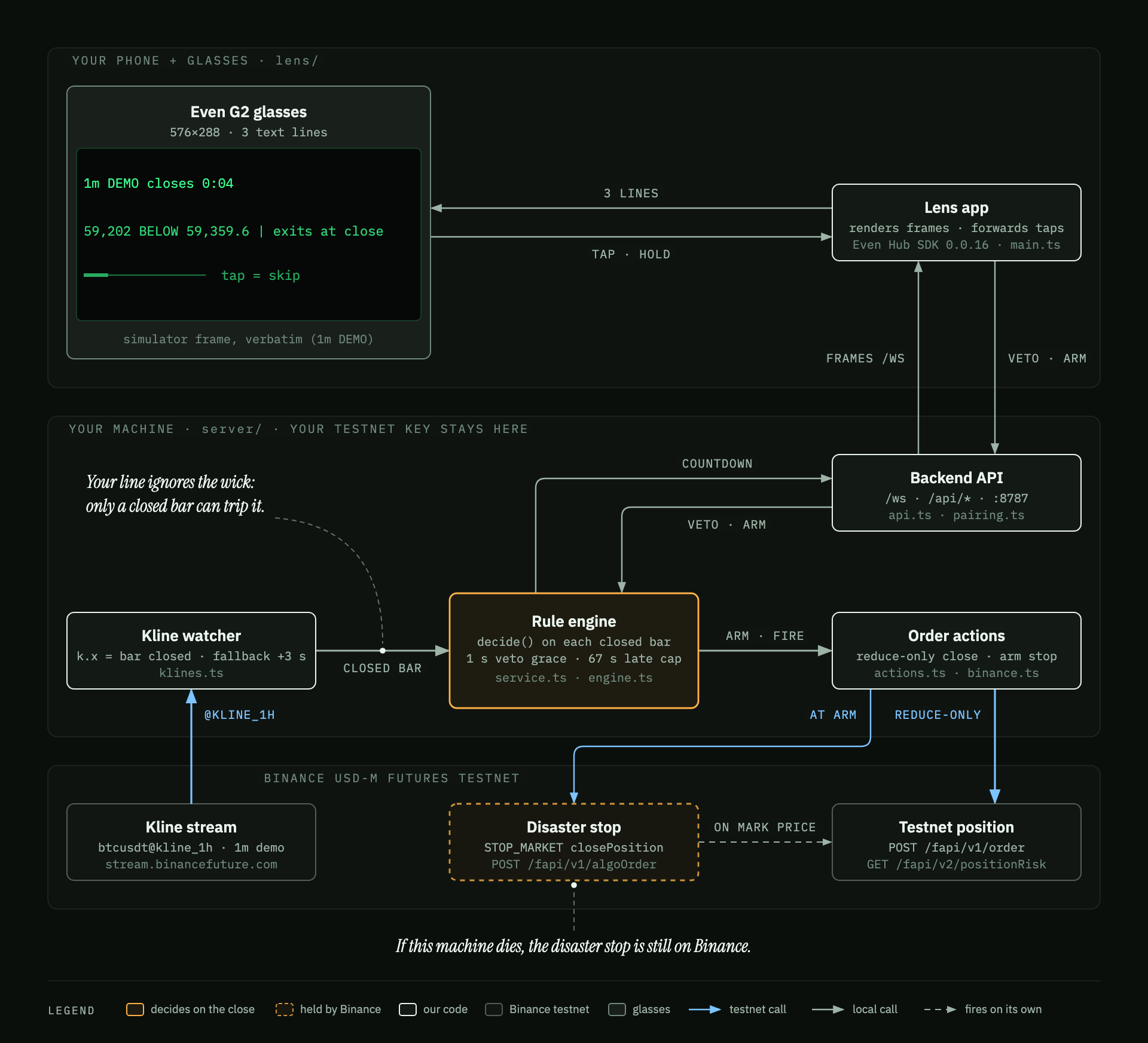
Your line decides at the close. A wider disaster stop, held by Binance itself, catches the disaster: it is there in case our server, the phone or the glasses die.

The candle’s close decides

The server watches Binance’s kline stream. When the bar is marked closed (k.x = true) and the close is past your line, it waits out a 1,000 ms grace for a late tap, then sends the order. A wick that closes back over the line sends nothing.

k.x = true→1,000 ms grace→vetoed?→close past your line?→reduce-only MARKET
close event p50 408 ms after the boundary · 12 of 13 bars within 2 s
<symbol>@kline_<interval> · k.x
One tap skips this close

In the bar’s last 60 s (20 s in the 1m demo) the glasses count down. A touchpad tap sends a veto for that bar only. The next bar decides again.

tap → lens handler 1 ms · WebSocket round trip 4 ms · the accepted simulator tap, one machine clock
Even Hub SDK · click

Reduce-only, always

The close is a MARKET order with reduceOnly: it can shrink or flatten your position, never open or add. The fill price is read back from the exchange.

POST /fapi/v1/order

A disaster stop underneath

Arming first places a wide STOP_MARKET on Binance; no stop, no arm. Testnet refuses the classic endpoint (-4120), so it goes through the algo endpoint. It is a normal price stop and can fire on a deep wick.

POST /fapi/v1/algoOrder

Your key stays home

The backend runs where your testnet key lives. The lens pairs with a single-use code and a bearer token and never sees a key; the order client refuses any non-testnet host.

pairing code · bearer token

576 × 288 · no font-size control in the SDK

Every rendered state fits in three lines.

These 16 cards were rendered in the simulator at their longest realistic content (layout fixtures, no orders). In the recorded testnet cycle every card drew three lines with no wrap (menu overlays aside); the widest line ends at x = 500 of 564.

Countdown · wrong side
Vetoed
Closed
Armed
Countdown · right side
Skipped
Grace (1,000 ms)
Reading the close
Closing
Held (closed on the right side)
Too late (tap after the close)
Closed by the disaster stop
Stop missing
Hedge mode refused
Offline
No close data

Select any card to see it at full size.

Where each decision lives.

  • Lens apprenders frames and forwards taps; holds a pairing token, never a key.
  • Backend on your machinewatches the kline stream, decides at the close, sends the order, manages the stop.
  • Binance Futures testnetfills the reduce-only close and holds the disaster stop when everything else is down.
Close Call architecture: Even G2 glasses and lens app, a backend on your machine that decides at the candle close, Binance Futures testnet with the disaster stop
drawn from the code as builtopen the full diagram →

Honest by design

What we did not prove.

Three of the README’s ten honest limits, word for word.

  • Simulator only. No Even G2 / R1 hardware was available; every glasses frame here comes from the Even Hub simulator 0.9.5.
    README · Honest limits #1
  • The disaster stop is a normal price stop and can fire on a deep wick. It is what bounds the loss from a mistaken veto or a dead backend, to roughly the stop distance plus slippage (untested here: no stop fired in the evidence).
    README · Honest limits #6
  • The demo uses a 1m interval mode (same engine, 20 s countdown) so a full cycle fits on camera. It is labelled 1m DEMO on the glasses and in the evidence. The staged breach (line set 150 USDT above the mark) is staged, and says so.
    README · Honest limits #3

Read all ten limits →

Questions a judge would ask.

Short answers, each backed by a file in the repo.

Open the evidence folder →

Did you run it on real G2 glasses?

No. No G2 or R1 hardware was available. Every frame on this page is an Even Hub simulator 0.9.5 framebuffer, recoloured to the page’s green. The two-bar cycle was driven through the simulator’s touchpad automation API; the card wall by a scripted stage backend (no orders). It is untested on hardware.

Is any order mocked?

No order on the demo path is mocked. Every file in evidence/orders/ comes from the testnet host with an exchange order id and timestamp, or an exchange error code (evidence gate: 88 pass, 7 legacy, 0 fail). The state wall above uses layout fixtures and says so.

What if I tap by mistake?

That bar’s close is skipped (VETOED) and the next bar decides again. The disaster stop stays on Binance the whole time, so the loss is bounded by roughly the stop distance plus slippage.

What if your server dies while armed?

The disaster stop resting on Binance is what covers that case. It was resting on Binance in every armed run in the evidence, though none has triggered yet. Arming is refused unless Binance accepted that stop first.

Why not just a stop order on Binance?

No Binance Futures order type we found triggers on a candle close. A price stop sells the touch, including a wick that closes back over your line: the 107 of 259 above.

Where does my API key live?

On the machine that runs the server, in an env file outside the repo or in exported variables. The glasses and the phone never see it; they hold a pairing token.

Why no voice?

Microphone input is unproven in the simulator, and a spoken instruction that moves money is a long dictation. During the countdown, one tap is the only interaction needed.

Arm it on testnet.

Bring your own Binance Futures testnet key, run the server, pair the simulator. Every step is in the README.